Note: This text reflects the evidence and care available for multiple myeloma in Germany. This overview is not a substitute for medical advice.
Table of Contents
- What Is multiple myeloma?
- Risk factors for multiple myeloma
- Symptoms of multiple myeloma
- Diagnostics for the assessment of multiple myeloma
- Course and prognosis of multiple myeloma
- Treatment of multiple myelom
- Follow-up of multiple myeloma
- Rehabilitation of multiple myeloma
- Living with multiple myeloma – practical tips
- Frequently asked questions about multiple myeloma
Multiple myeloma at a glance
- Multiple myeloma is a cancer of plasma cells. These cells usually produce antibodies that help to fight infections. Myeloma cells produce an abnormal, dysfunctional antibody.
- The cancerous cells can cause bone pain and fractures as well as anaemia and a compromised immune response. The abnormal antibody can lead to kidney dysfunction and blood clots among other complications.
- Compared to other cancer types, multiple myeloma is rare: in Germany, about 7,000 people are diagnosed with multiple myeloma each year.
- If you have been diagnosed with multiple myeloma, your treatment depends on your personal risk of recurrence, your general state of health, accompanying illnesses, previous treatments and biological age. Treatment options include monoclonal antibodies, immunomodulatory drugs, targeted drugs and corticosteroids. High-dose chemotherapy in combination with blood stem cell transplantation and modern immunotherapies can also be useful options.
- To date, myeloma is still incurable. However, with modern therapies, doctors can often control the disease for many years.
What Is multiple myeloma?
In multiple myeloma, abnormal plasma cells divide uncontrollably. They may accumulate in several places in the bone marrow. This is where the name ‘multiple’ comes from.
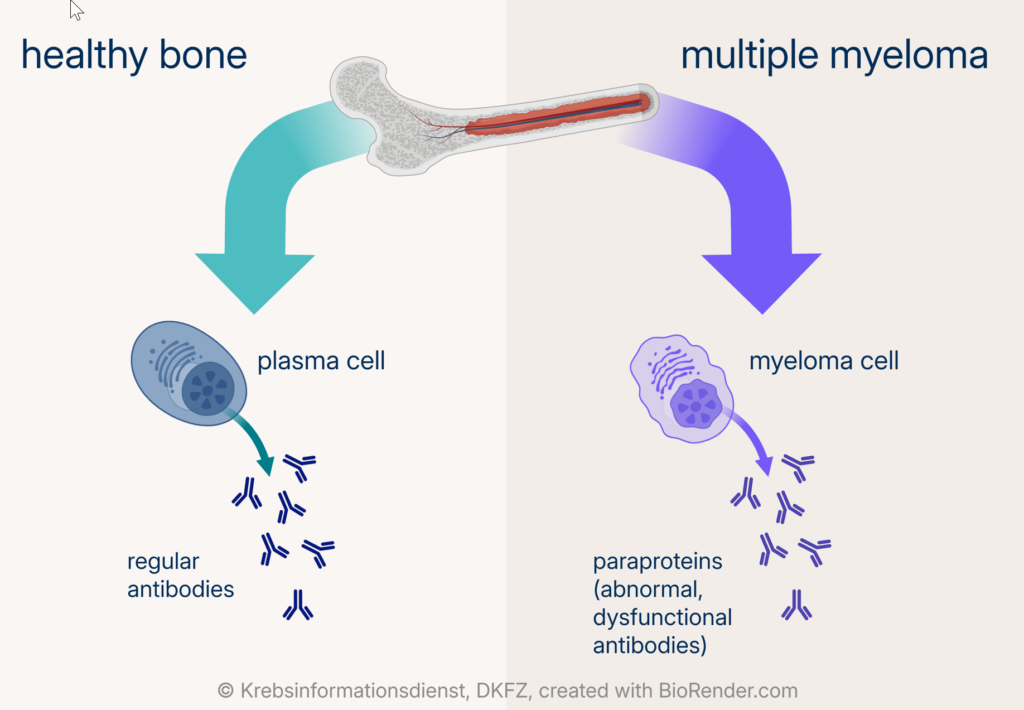
Healthy plasma cells in the bone marrow generate antibodies to fight infections. In the case of multiple myeloma, cancerous plasma cells (myeloma cells) build up in the bone marrow and produce a monoclonal protein, the so-called paraprotein.
Myeloma cells usually generate an abnormal protein known as paraprotein. This can affect the blood, kidneys and other organs. Bone damage caused by myeloma cells is also possible.
How common is multiple myeloma?
Multiple myeloma is one of the more common blood cancers, and primarily occurs among the older population. Furthermore, men are slightly more likely to be affected than women.
Incidence in Germany
Approximately 7,000 people are diagnosed with multiple myeloma every year.
Risk factors for multiple myeloma
The cause of multiple myeloma is unknown. Possible risk factors include:
- Age: The risk increases with age.
- Gender: Men are slightly more likely to be affected.
- Family history: Related family members have an increased risk if the disease is present among biological relatives.
- Precursor MGUS: Monoclonal gammopathy of undetermined significance (MGUS) is considered a precursor to multiple myeloma. It is not a cancer, but about 10 to 15 of 100 people affected will be diagnosed with multiple myeloma within the next 10 years.
Other risk factors such as certain chemicals, radiation and obesity are also being discussed.emicals, radiation and obesity are also being discussed.
Symptoms of multiple myeloma
In the early stages, the symptoms of multiple myeloma are often non-specific, and doctors may discover the disease by chance.
Possible signs you may notice:
- bone pain
- fatigue, weakness and decreased performance
- frequent infections
- foamy urine, frequent urination
Less commonly, nausea, thirst, vomiting or confusion may occur if calcium levels in the blood are too high. In addition, vision problems, memory problems, dizziness, and/or circulatory disorders are possible. These symptoms can happen if the blood becomes too thick/viscous due to the paraprotein produced by myeloma cells. If the paraprotein is deposited in specific organs, organ-related symptoms may occur.
When should I see a doctor?
Many symptoms can be caused by other diseases. Seek medical advice if such symptoms persist or become more severe.
Diagnostics for the assessment of multiple myeloma
Doctors use various tools and techniques to diagnose multiple myeloma.
- Medical history consultation and physical examination: Doctors will ask you about symptoms, previous illnesses and other risk factors.
- Blood and urine tests: Doctors will look for an abnormal protein (paraprotein) in both blood and urine if they suspect multiple myeloma. They will also check your blood count, electrolytes, kidney function and other laboratory parameters.
- Bone marrow biopsy: For further clarification, doctors take a sample from your bone marrow using a special needle. Specialists examine the sample to determine whether myeloma cells are present, and if so, how many. These cells are then examined for typical genetic changes.
- Imaging: Imaging tests are done to look for bone changes. Usually you undergo a full-body low-dose computed tomography (CT) scan. This allows doctors to assess how far multiple myeloma has spread in your bones, and how much damage has been caused. Magnetic resonance imaging (MRI) or positron emission tomography (PET)/CT scans may sometimes be used as a supplement, but they are not a part of the standard examinations in Germany for multiple myeloma.
When should treatment begin?
The CRAB criteria help to assess when it is appropriate to start treatment:
- Calcium too high,
- Renal (kidney) damage,
- Anaemia (low red blood cell count),
- Bone damage.
Treatment is usually also started if one of the so-called SLiM characteristics is present:
- Sixty percent or more of the cells in the bone marrow are myeloma cells,
- Light chains (small blood proteins) show abnormal values,
- MRI shows bone damage.
Course and prognosis of multiple myeloma
The course of multiple myeloma varies greatly. Some people live for a long time with few symptoms, while for others the disease progresses more rapidly.
The prognosis of multiple myeloma has improved significantly in recent years because new drugs are available. If left untreated, the disease will sooner or later prove fatal.
Important to know
The treatment team uses laboratory values and genetic findings from the bone marrow sample, among other factors, to assess your individual risk of disease progression.
Treatment of multiple myelom
Multiple myeloma therapy goals
- suppress the disease
- alleviate symptoms
- protect organs
- maintain the highest possible quality of life among those affected
Some patients achieve remission, a temporary regression of the signs of the disease.
Types of treatment
Your individual treatment plan depends, among other things, on features and symptoms of your myeloma, your general health and your age.
Treatment options:
- multi-drug therapy
- high-dose chemotherapy followed by a blood stem cell transplant
- immunotherapy
- radiation therapy
- supportive care (for all patients)
The appropriate treatment depends on the patients’ state of health, age and any concomitant diseases.
Clinical trials
Researchers are investigating new treatment options in clinical trials.
Treatment of newly diagnosed multiple myeloma
The first treatment of multiple myeloma often consists of a combination of four drugs:
- a targeted therapy with a monoclonal antibody (daratumumab or isatuximab)
- an immunomodulatory drug (e.g. lenalidomide)
- a targeted therapy with a proteasome inhibitor (e.g. bortezomib)
- a corticosteroid (dexamethasone)
After several cycles of multi-drug therapy patients in good general health might proceed to high-dose chemotherapy to destroy as many myeloma cells as possible. Since high-dose chemotherapy also affects healthy cells, the person’s own blood stem cells are subsequently infused to rebuild healthy bone marrow (so-called autologous stem cell transplant).
A continuous (maintenance) therapy is given to increase a patient’s time in remission.
Preventing and treating bone damage
Multiple myeloma can damage bones. Patients therefore also receive accompanying therapies to prevent or treat bone damage.
- Bone-stabilising drugs such as bisphosphonates or denosumab strengthen the bones and prevent bone pain and fractures.
- Radiotherapy provides targeted relief for painful or fracture-prone areas of bone.
- Surgery may be necessary if bone fractures have occurred.
Preventing infections
Infections are a serious risk for people with multiple myeloma because
- the disease itself weakens the immune system, and
- many treatments further reduce the body’s ability to fight infections.
To reduce the risk of infections, the following measures are important:
- Keeping vaccinations up to date.
- Preventive medications when needed.
- Early medical treatment at the first signs of infection.
In some cases, replacement of immune proteins (immunoglobulins).
Treatment of relapsed multiple Myeloma
If the disease returns or the current treatment becomes less effective, the next treatment is chosen based on
- how well previous therapies worked,
- how well they were tolerated, and
- the patient’s overall health and preferences.
Today, modern immunotherapies are available to treat relapses. Examples are:
- CAR-T cell therapy: In CAR-T cell therapy the body’s own defence cells are modified in the laboratory so that they specifically attack myeloma cells.
- Bi-specific antibodies: Bispecific antibodies are designed to attach to a myeloma cell and an immune cell at the same time. Due to the close proximity the immune cell is able to directly attack and kill the myeloma cell.
When is CAR-T cell therapy an option?
CAR-T cell therapy can be used as a second-line treatment, for when the first treatment for multiple myeloma no longer works.
In Europe, two different CAR-T cell therapies are approved, and one of them is available for treating myeloma patients in Germany.
Follow-up of multiple myeloma
As multiple myeloma is not curable, patients will receive lifelong follow-up. The aim is to detect possible disease progression and to treat short- and long-term side effects of the therapy.
- Regular check-ups: Doctors check blood and urine parameters, conduct imaging if necessary, and check for side effects and signs of relapse. The intervals between check-ups depend on your individual situation.
- Vaccinations: Standard vaccinations are recommended. Depending on the situation, additional vaccinations against other infectious pathogens, such as the influenza virus and pneumococcal bacteria, may be recommended. Following a stem cell transplant, your vaccination protection must be re-established.
Rehabilitation of multiple myeloma
For many patients, a rehabilitation
process may follow therapy. The aim is to address any side effects, to assess potential long-term and late effects caused by the therapies you received, and to reduce unwanted side effects as much as possible. Rehabilitation may include exercise therapy, physiotherapy/occupational therapy, nutritional counselling and social counselling.
When should my rehabilitation start?
As multiple myeloma is a progressive disease, there is no specific recommended time for rehabilitation.
For instance, your rehabilitation can take place between two treatment blocks.
Living with multiple myeloma – practical tips
You can do a number of things to improve your quality of life and cope with the disease.
- Infection control: Vaccination boosters may already be part of your follow-up care. Treatments may weaken your immune system. It is therefore important to pay attention to hygiene, and to see a doctor if you have any signs of infection (such as fever and feeling generally unwell).
- Treating pain: Talk openly about pain. Some over-the-counter medicines (e.g. certain painkillers) can put additional strain on the kidneys – please consult your doctor before taking new medications.
- Drink enough: Drinking enough water is important for myeloma patients in order to support their kidneys. Discuss with your treatment team what would be an appropriate amount of daily fluid intake.
- Exercise if possible: Regular, appropriate activity can improve your fitness and mood. If you have bone damage, discuss with your doctors beforehand which activities are safe.
- Seek psychosocial support: Psycho-oncological services and social counselling can provide relief and help you get back to everyday life. You can find support at cancer centres, rehabilitation clinics or through specialised counselling centres.
Frequently asked questions about multiple myeloma
In this section, you can find short answers to frequently asked questions about multiple myeloma.
Yes. Multiple myeloma is a type of blood cancer. It starts in plasma cells, which are a special kind of white blood cell found mainly in the bone marrow. Plasma cells develop from B cells, so multiple myeloma belongs to a group of blood cancers called B-cell neoplasms.
Multiple myeloma can exist for a long time without causing symptoms. Many cases are found by chance during routine blood or urine tests. Up to 1 in 4 people have no symptoms when the disease is diagnosed.
Common symptoms can include bone pain (often in the back), tiredness, weakness, frequent infections, loss of appetite, weight loss, nausea, and/or symptoms related to kidney problems such as foamy urine or needing to urinate often. Less often, people may have vision or memory problems, dizziness, bleeding or nerve pain.
Multiple myeloma is usually not curable. However, it can often be well controlled for many years. With treatment, symptoms may improve or disappear for a time — this is called remission. Treatments such as high-dose chemotherapy with a blood stem cell transplant can help control the disease, and life expectancy has greatly improved in recent years.
The exact cause of multiple myeloma is not known, and you did not do anything wrong.
Most risk factors – such as older age, being male or a positive family history for myeloma – cannot be changed. Exposure to benzene and some other organic solvents is one potential risk factor that can be avoided. However, it is not possible to know what exactly caused the disease because cancer usually develops due to several factors acting together.
The CRAB criteria describe signs that multiple myeloma is causing damage to the body.
CRAB stands for
- high calcium levels in the blood (C),
- kidney problems, renal insufficiency (R),
- anemia or low red blood cells (A), and
- bone damage (B).
If one or more of these signs are present, blood and bone marrow tests may lead to the diagnosis of multiple myeloma.
CAR-T cell therapy is currently used for patients whose myeloma has come back or did not respond to prior treatments. The therapy can reduce signs of the disease and improve symptoms. In some patients, these improvements can last for a long time.
You can read about what CAR-T cell therapy is, and what side effects it has, in the text: ‘Immunotherapy for cancer’.
Yes, many people with multiple myeloma can live a fairly normal life.
Life may be limited at times, but you do not have to give up everything. When you return to everyday life with multiple myeloma, there are a few things you should keep in mind. It is important to prevent infections, follow basic hygiene rules, keep your vaccinations up to date and drink enough fluids to protect your kidneys. Always talk to your doctor if you have pain or signs of infection, or if you have questions regarding new or existing medications.
Further resources and reliable information
Evidence-base guidelines
Oncology Guidelines Programme (German Cancer Society, German Cancer Aid, AWMF): Diagnosis, treatment and follow-up care for patients with monoclonal gammopathy of undetermined significance (MGUS) or multiple myeloma, long version 1.0, 2022, AWMF registration number: 018/035OL (accessed on 31.12.2025).
Self-help for multiple myeloma
The experiences of other people with the same disease can be very individual and yet extremely valuable. Cancer self-help groups provide information and practical tips, but also offer a forum for discussion, encouragement and comfort.
Patients with multiple myeloma can contact the following nationwide associations:
- The German Leukaemia and Lymphoma Aid (DLH) is the federal association of self-help organisations supporting adults with leukemia and lymphoma. It offers support and information in regional groups, at events and through brochures.
- The Multiple Myeloma Working Group (AMM-Online) sees itself as a supra-regional online network in German-speaking countries. Its main focus is on providing an online forum for those affected, but it also offers information about the disease and a list of studies.
- The non-profit association Myelom.Online e.V. is a nationwide self-help and patient organisation. Its services are aimed at people affected by multiple myeloma and their relatives.
- For those interested who have a knowledge of English, the homepage of the Lymphoma Coalition is also suitable. This global network of patient groups offers contact points for patients in many countries.
Information Websites
- Cancer Information Service (DKFZ):Topic portals on risk factors, symptoms, diagnosis, treatment, aftercare/rehabilitation and living with myeloma.
- gesund.bund.de: Patient information with additional overview of care and contact points (in German, English, Turkish, Ukrainian and Arabic).
Created by
at
changed at