Table of Contents
- What is targeted therapy and how does it work?
- Who can be treated with targeted therapy?
- How do I receive targeted therapy?
- What side effects should I expect from targeted therapy?
- Frequently asked question about targeted therapy
- Further resources and reliable information
Note: This overview is not a substitute for medical advice.
Targeted therapy at a glance
- Targeted drugs specifically interfere with processes that are important for tumour growth.
- Whether the treatment is suitable for you depends on your tumour type, the stage of the disease, and the biological characteristics of the cancer cells.
- Doctors may test your cancer cells for these characteristics during diagnosis: under a microscope or with special laboratory tests.
- If you get targeted therapy, you will usually receive it as an infusion or tablet. Sometimes, it may also be given as an injection under the skin.
- Since targeted therapy focuses more directly on cancer cells, it can cause fewer side effects than chemotherapy. Nevertheless, side effects such as skin and hair problems or diarrhoea are possible.
What is targeted therapy and how does it work?
Targeted therapy is a cancer treatment that focuses on specific molecular changes in cancer cells. These changes promote the growth, survival, and spread of cancer cells. There are different types of targeted therapies with different targets in or on cancer cells. Each type works in a specific way. A common type of targeted drug blocks the signals that tell cancer cells to grow.
How they work: In the body, cell growth and division are usually carefully controlled. Cells receive messages through special signalling molecules. If these signals do not work properly, cells can multiply uncontrollably and cancer can develop. Growth inhibitors stop this process by blocking these messages.
For example, targeted drugs can
- intercept signalling molecules,
- block signals at the surface of the cancer cells, or
- interrupt signalling pathways inside the cancer cells
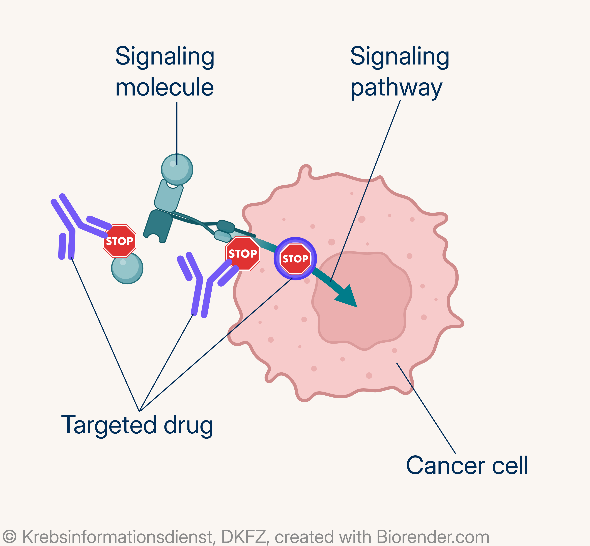
Targeted drugs can block uncontrolled growth at different points of the signalling pathway, either outside or inside the cancer cell.
Other targeted drugs
- stop tumours from forming new blood vessels, which they need to survive
- block the disposal of waste products from cancer cells
- carry cancer-killing substances directly to the cancer cells
- inhibit the repair of damaged genetic material in cancer cells
- promote the suicide programme of cancer cells
There are two main types of targeted therapies:
Small-molecule drugs: They are small enough to enter cancer cells and do their job inside the cell.
Monoclonal antibodies: These are lab-made proteins that attach to specific targets outside or on the surface of cancer cells.
Who can be treated with targeted therapy?
Targeted drugs are used to treat a wide variety of cancers. They are suitable, for example, for some patients with breast, lung or colon cancer and for certain patients with leukaemia. However, targeted therapies are not available for every type of cancer.
Most of the drugs are approved for the treatment of advanced disease. This means they are used when the cancer cannot be cured. In this situation, the medicines can slow down cancer growth or shrink the tumour and reduce symptoms. Sometimes, the therapy can control the cancer for a long time, but cancer cells can also become resistant.
Some targeted drugs can also be used in early cancer stages. For example, in certain types of breast or lung cancer. In such cases, the targeted drugs are usually used in combination with other forms of therapy such as surgery.
Clinical trials
Researchers are testing further targeted drugs in clinical trials to see how they work in other cancer types or in other stages of the disease.
Testing at diagnosis
Targeted therapy is a form of precision or personalised medicine with treatment being based on the unique characteristics of a patient’s tumour. Depending on the situation, these characteristics may need to be tested for at diagnosis.
Molecular tests:
Doctors look for these characteristics by examining the cancer cells with a microscope or by conducting special laboratory tests. To do this, attending physicians take a sample of the cancer tissue during a biopsy or tumour surgery. In some patients, cancer cells can be collected from the blood.
How do I receive targeted therapy?
This depends on which type of drug you are receiving:
Small-molecule drugs are pills or capsules that you can take orally. You can take them at home, usually every day.
Monoclonal antibodies are given as an infusion through a vein or as an injection under the skin. You receive infusions and injections at specific intervals, for example weekly or every two weeks. A single infusion usually takes anywhere from thirty minutes to two hours. If you are also receiving chemotherapy, you will probably have additional infusions on the same day. The therapy usually takes place on an outpatient basis in a specialist practice or in the outpatient department of a hospital. If there is a high risk of complications, inpatient treatment may be more appropriate.
The targeted therapy can be combined with other forms of therapy. These may include surgery, chemotherapy, hormone therapy, immunotherapy or radiotherapy. It is also possible to combine several targeted drugs.
How other medicines and food may affect your treatment
Targeted medicines can interact with other drugs. This means they may work less well or cause more side effects. Before you begin your treatment, your attending physician will explain which medications you can continue to take as normal and which ones you may need to change to another product or pause.
- Do not stop or start any medications without first consulting your attending physician. This also applies to over-the-counter medicines, dietary supplements, and other forms of complementary medicine.
Targeted medicines can also interact with food. Eating food can change how your body absorbs and processes medications, which can affect how well they work.
- Especially with oral medications, follow the dosage instructions exactly. Determine whether you need to take the medication before, during or after meals.
How long does the treatment take overall?
If you have advanced disease, you usually receive the drugs for as long as they are effective or until unacceptable side effects occur.
In earlier stages of the disease, the duration of treatment depends on which medication you receive and what type of cancer you have.
Check-ups
If you take targeted therapy long-term, you will need regular check-ups to see how your cancer is responding to the treatment.
What side effects should I expect from targeted therapy?
Because targeted therapy is more precise, it can result in fewer side effects compared to a traditional chemotherapy. However, side effects are still possible. Although often found in smaller amounts, the targets of the drugs are also found in healthy cells.
The side effects you experience depend on the specific drug taken, and not everyone reacts in the same way. Most of the side effects usually improve after finishing the therapy.
Here are the most common side effects of targeted drugs:
Skin, hair and nails: You might have problems such as
- redness
- small pustules
- itching
- inflammation
- calluses
- brittle hair or hair loss
These symptoms can appear within a few days after starting treatment, or only weeks to months afterwards. In the text Hair, Skin and Mucosa you will find tips on what to do if these side effects occur.
Diarrhoea: You might suffer from diarrhoea during therapy with targeted drugs. If you experience this side effect, you can find information regarding potential solutions in the text Gastrointestinal Problems.
Heart and circulatory system: Drugs that block the formation of new blood vessels can have side effects involving the cardiovascular system. These can include the formation of blood clots (thrombosis) or high blood pressure.Depending on individual risk, attending physicians will measure your heart function and blood pressure regularly. If problems occur, they can often be treated with medication.
Thyroid and liver: Some targeted drugs can affect thyroid function or cause liver problems.If you are taking a medication known for these side effects, doctors will regularly check your thyroid and liver values.
Talk to your doctors
- You should discuss possible side effects with your doctors before starting treatment.
- If you notice any side effects during treatment with a targeted drug, you should consult your doctors.
- They can advise you on what you can do to prevent side effects or relieve symptoms, and which medicines or supportive measures can help.
- If the side effects become too strong, the treatment may need to be temporarily paused. Only in rare cases does it need to be stopped completely.
Frequently asked question about targeted therapy
In this section, you can find short answers to frequently asked questions about targeted therapy.
The main difference is the target of the drugs:
- Chemotherapy affects all fast-growing cells.
- Immunotherapy acts on your immune system to help it fight the cancer.
- Targeted therapy acts on specific changes in and on the cancer cells to stop them from growing.
Whether it works for you depends on your tumour type and the stage of the disease. In addition, doctors test your cancer cells for biomarkers – special features that the drug can target. These features can be identified with a biopsy, or in some situations, with a blood test.
In many cases, yes. Coverage depends on the specific medicine, the approved use, and your test results. Your health care team can help clarify this.
This depends on the type of cancer and the tumour’s specific features. If your tumour has the right characteristics, targeted therapy can work very well.
Depending on the medication, it may be a tablet or capsule you take orally every day, or an infusion or injection given at regular intervals. Your doctor will explain the schedule that applies to you.
Do not take extra medicine. Contact your doctor or pharmacist for instructions.
Sometimes the goal is to cure the cancer. In other cases, the treatment aims to slow downprogressionor control symptoms.
Cancer cells can change over time. If this happens, your medical team will look at other treatment options, such as a different targeted therapy, immunotherapy or other cancer treatments.
Many patients can continue with their daily routines. But some people may feel tired or have other symptoms like skin problems or diarrhoea. Your doctor can help you manage side effects.
The main difference is the target of the drugs:
- Chemotherapy affects all fast-growing cells.
- Immunotherapy acts on your immune system to help it fight the cancer.
- Targeted therapy acts on specific changes in and on the cancer cells to stop them from growing.
Further resources and reliable information
- Evidence-based guidelines
- Experts summarise the disease situations in which targeted therapy is recommended in medical guidelines. A compilation of guidelines for different cancer types is provided by Leitlinienprogramm Onkologie (in German). Many of the guidelines have a version for patients.
- Information Websites
- Cancer Information Service (DKFZ): Overview on targeted therapy an other cancer treatments.
- Medication specific information
- The source for statements on medications is the manufacturers’ current specialist information (available at www.fachinfo.de; accessible to specialists). Drug information is also available in other German-language databases (mostly subject to a fee, e.g. www.pharmnet-bund.de/dynamic/de/arzneimittel-informationssystem/index.html). The “Bundesinstitut für Arzneimittel und Medizinprodukte” (BfArM) and the European Medicines Agency (EMA) also offer comprehensive drug information. The “Institut für Qualität und Wirtschaftlichkeit im Gesundheitswesen” provides evidence-based reports on the significance of new medications (“Early benefit assessment” according to AMNOG or §35a, SGB V).
Created by
at
changed at